
ATO Market Valuations & Business Valuations for Tax Purposes
Independent, professional business valuations prepared for Australian taxation purposes.
BSP Strategic provides independent ATO market valuations and business valuations for tax purposes, including Capital Gains Tax (CGT), Division 152 Small Business CGT Concessions, business restructures, related-party transactions and other circumstances where the market value of a business, shares or business interests needs to be established.
For taxation purposes, a business valuation needs to be more than an estimate of value. The valuation should be prepared for the relevant purpose and valuation date, supported by appropriate methodology, credible evidence and clearly documented assumptions, and be capable of withstanding professional and regulatory scrutiny.
BSP’s business valuations are prepared by a CA ANZ Business Valuation Specialist with a focus on providing independent, evidence-based conclusions that are replicable and defensible.
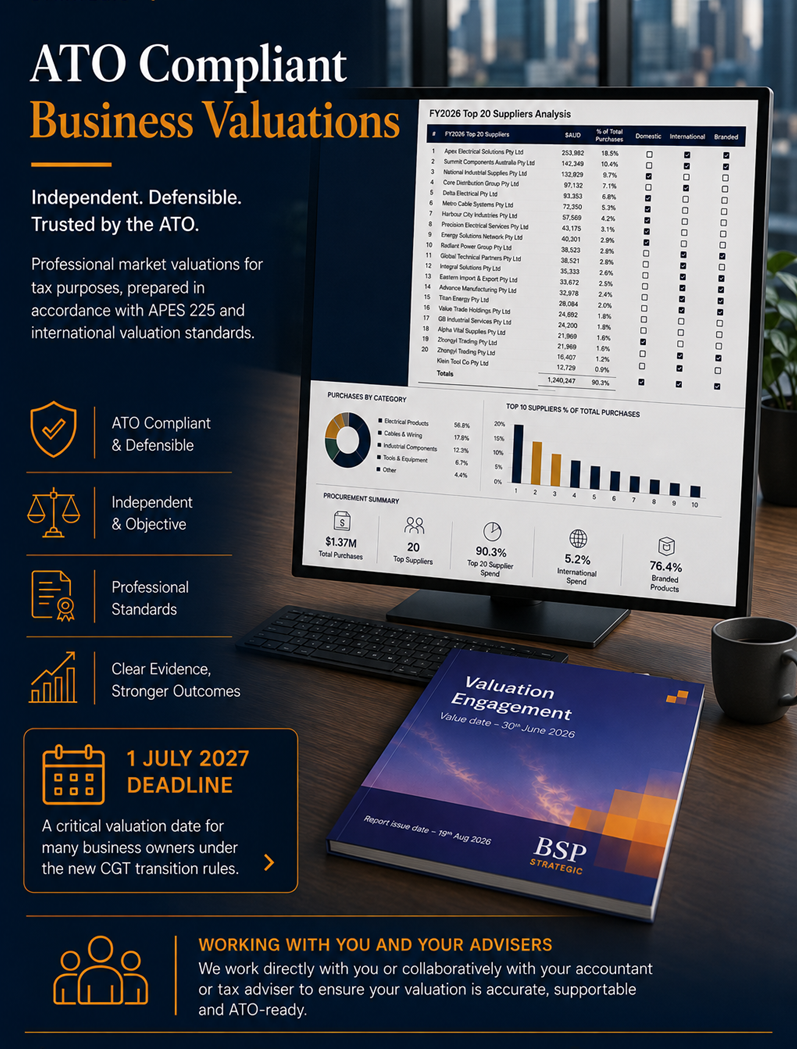
ATO Market Valuations & Valuations for Tax Purposes
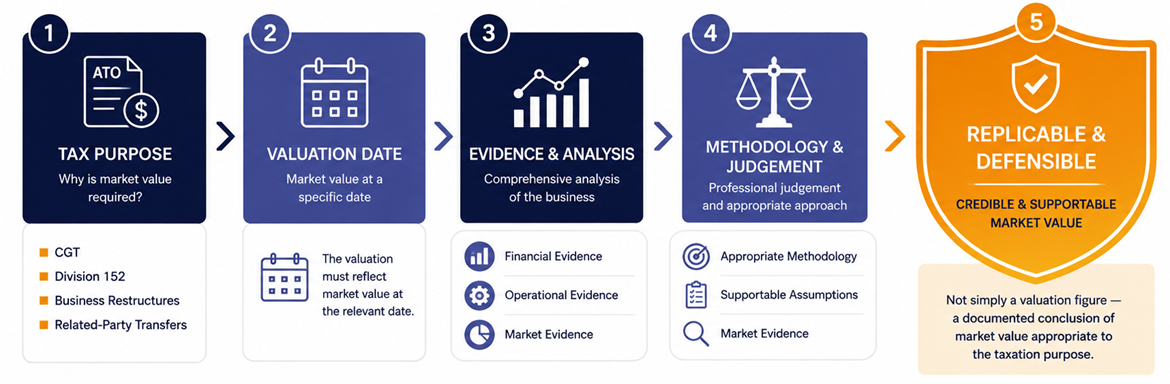
Australian taxation laws can require the market value of a business, shares or business interests to be established for a range of taxation purposes. Depending on the circumstances, this may arise in connection with Capital Gains Tax (CGT), the Division 152 Small Business CGT Concessions, business restructures, transfers between related parties or other transactions where market value is relevant to determining a taxation outcome.
A business valuation for tax purposes is different from an informal estimate of what a business might be worth or what it could potentially achieve if offered for sale. It must address the specific purpose for which the valuation is required and determine market value at the relevant valuation date.
For taxation purposes, the underlying valuation process is particularly important. The valuation methodology should be appropriate to the business and the relevant taxation purpose, key assumptions should be supportable, and the conclusion should be based on credible financial, operational and market evidence.
The ATO’s guidance places considerable importance on valuations being capable of being replicated and defended. This requires the valuation process to be appropriately documented, relevant records to be retained, and the methods and inputs used to determine market value to be clearly supported.
For business owners, this means the objective is not simply to obtain a valuation figure. It is to establish a credible and supportable assessment of market value that is appropriate for the taxation purpose for which it has been prepared.
When Might a Business Valuation Be Required for Tax Purposes?
There are a range of circumstances where Australian taxation provisions may require, or make it important, to establish the market value of a business, shares or business interests.
The precise valuation requirement will depend on the relevant taxation provision and the circumstances of the taxpayer. Common situations where an independent business valuation for tax purposes may be required include:
1. Capital Gains Tax (CGT)
Market value can become important when determining the taxation consequences of a CGT event involving a business, shares, units, goodwill or other business interests.
Common situations where a business valuation may be relevant include:
- the sale or transfer of shares in a privately owned company, particularly where there is no readily observable market price;
- the sale or transfer of an interest in a business between existing owners, shareholders or family members;
- a business restructure involving the transfer of a business, shares, goodwill or other assets between entities;
- the admission, retirement or change in interests of business owners where the value of an underlying business interest needs to be established;
- determining the market value of a business or business interests when considering eligibility for the Division 152 Small Business CGT Concessions;
- transactions between related parties or parties not dealing at arm’s length, where the agreed consideration may not reflect market value;
- establishing the value of goodwill or other intangible business assets as part of a CGT-related transaction; and
- circumstances requiring a historical or retrospective market valuation at the date of an earlier CGT event.
In some circumstances, the CGT market value substitution rules can apply so that market value is used instead of the amount actually paid or received. This can arise, for example, where parties are not dealing at arm’s length and the transaction price does not reflect market value.
The relevant CGT treatment will depend upon the particular transaction and taxation provisions involved. Business owners should also consider discussing with their accountant or tax advisor the merits of also calculating the value of asset at 1 July 2027 using Treasury’s proposed Apportionment Method. BSP Strategic therefore works with the client’s accountant or taxation adviser to establish the appropriate valuation purpose, asset or business interest being valued and valuation date before undertaking the valuation.
2. Division 152 Small Business CGT Concessions
The Division 152 Small Business CGT Concessions can provide significant Capital Gains Tax relief to eligible business owners when a business or qualifying business asset is sold.
The four existing small business CGT concessions include:
- the 15-year exemption;
- the 50% active asset reduction;
- the retirement exemption; and
- the small business rollover.
Eligibility depends on satisfying a range of conditions under Division 152. Under the existing rules, an important gateway to accessing the concessions is generally satisfying either the $2 million aggregated turnover test or the $6 million Maximum Net Asset Value Test, together with the other applicable eligibility requirements.
2026–27 Budget Changes to the Turnover Threshold
Following the 2026–27 Federal Budget and subsequent consultation, the Australian Government announced an important expansion to the small business CGT concessions.
From 1 July 2027, businesses with annual turnover of up to $10 million will be able to access the 50% active asset reduction, subject to satisfying the applicable eligibility requirements.
This represents a significant increase from the existing $2 million turnover threshold for accessing that concession and is expected to substantially increase the number of Australian businesses able to benefit from the 50% active asset reduction.
Importantly, the announced $10 million turnover threshold relates specifically to eligibility for the 50% active asset reduction. It should not be interpreted as a general increase of the existing $2 million turnover threshold applying across all four Division 152 concessions.
The four existing small business CGT concessions are being retained, but their individual eligibility requirements and interaction with the broader CGT reforms should be considered with an appropriately qualified taxation adviser.
Why Business Valuation Remains Important
For business owners who do not satisfy an applicable turnover test, the $6 million Maximum Net Asset Value Test can provide an alternative pathway to accessing the Division 152 concessions, subject to the other eligibility conditions being satisfied.
This makes the accurate determination of market value particularly important.
Where a privately owned business, shares, units or other business interests form part of the relevant asset calculation, there is generally no observable market price available. An independent business valuation may therefore be required to establish and support the market value of those interests at the relevant time.
This can become particularly important where the business owner’s net asset position is approaching the $6 million threshold, as relatively small differences in the assessed market value of a business or business interest may affect whether the Maximum Net Asset Value Test is satisfied.
BSP Strategic prepares independent Division 152 business valuations and market valuations for tax purposes, working with clients and their taxation advisers to establish the appropriate valuation scope, valuation date and business interests to be valued.
Taxation advice: Division 152 eligibility can be complex and depends on the taxpayer’s individual circumstances. BSP Strategic provides business valuation advice and does not provide taxation advice. Eligibility for the Small Business CGT Concessions should be confirmed with your accountant or taxation adviser.
3. Business Restructures and the 2026–27 Budget Restructure Window
Business restructures can involve the transfer of a business, shares, units, goodwill or other assets between entities as owners seek to establish a structure that is better suited to the future operation, ownership or succession of the business.
The 2026–27 Federal Budget has made this particularly relevant for businesses currently operating through discretionary trusts.
As part of the Government’s broader taxation reforms, a new 30% minimum tax rate is proposed to apply to discretionary trusts from 1 July 2028, subject to specified exemptions.
To assist small businesses and others that may wish to change their structure in response to these reforms, the Government has also announced a three-year restructuring window commencing 1 July 2027, during which rollover relief will be available for eligible restructures.
The announced relief is intended to allow businesses to restructure into alternative structures, including a company or fixed trust, without triggering income tax or Capital Gains Tax liabilities solely as a consequence of the restructure, subject to the final eligibility requirements and legislation.
Why Market Valuation May Be Important When Restructuring
While rollover relief may defer or remove an immediate taxation liability arising from an eligible restructure, determining the market value of the underlying business, shares, units, goodwill or other business interests may nevertheless be important as part of planning, documenting or implementing a restructure.
An independent business valuation can assist business owners and their taxation advisers to:
- establish the market value of the business or relevant ownership interests at the applicable valuation date;
- identify and support the value attributable to goodwill and other intangible assets;
- establish the relative value of shares, units or other interests being transferred or reorganised;
- support transactions involving related entities or parties where there is no observable arm’s-length transaction price;
- provide an independently supported value for restructuring documentation and professional advice; and
- establish an appropriate valuation record where the restructure may have implications for future CGT events.
The valuation requirements will depend on the particular restructuring strategy and the taxation provisions being relied upon. Accordingly, the appropriate valuation purpose, valuation date, assets or interests being valued and basis of value should be established before the valuation commences.
BSP Strategic can work alongside a client’s accountant, taxation adviser and legal advisers to provide an independent market valuation of the business or relevant business interests required to support the restructuring process.
4. Transfers of Shares, Units or Business Interests
The transfer, issue or reorganisation of privately held shares, units or ownership interests can create circumstances where market value needs to be determined.
Unlike listed securities, privately held business interests generally do not have an observable market price. Establishing market value may therefore require a detailed assessment of the underlying business, its earnings, assets, risks and other factors influencing value.
5. Historical or Retrospective Valuations
In some circumstances, the market value of a business, shares or business interests needs to be established at a date in the past rather than at the current date.
A historical or retrospective business valuation seeks to determine what the relevant business or business interest was worth at a specified earlier date, based on the information, circumstances and market conditions that existed at that time.
Historical valuations can arise in connection with Capital Gains Tax (CGT), business restructures, changes in ownership, related-party transactions and other taxation matters where the value of a business or business interest needs to be established at a particular historical date.
The Importance of 1 July 2027 Under the New CGT Rules
The Government’s 2026–27 tax reforms make 1 July 2027 a particularly important valuation date for many business owners and investors holding CGT assets before that date.
Under the new arrangements, the existing 50% CGT discount continues to apply to eligible capital gains that accrued before 1 July 2027. Gains accruing from 1 July 2027 are instead subject to the new CGT arrangements, including cost-base indexation and the applicable minimum tax provisions.
For assets held before 1 July 2027 and disposed of at a later date, it may therefore be necessary to determine the value of the asset as at 1 July 2027 in order to distinguish between gains accruing before and after the commencement of the new CGT regime.
The Government has provided two methods for establishing an asset’s value at 1 July 2027. A taxpayer may:
- obtain a valuation of the asset as at 1 July 2027; or
- use the Government’s specified apportionment methodology to estimate the value at that date.
For owners of privately held businesses, shares and other business interests, obtaining an independent business valuation may provide a more specific assessment of market value based on the circumstances of the particular business at 1 July 2027.
Why Contemporaneous Valuation Evidence May Be Valuable
Although a valuation can be undertaken retrospectively, establishing and documenting market value at or around 1 July 2027 may have practical advantages for business owners who expect to retain and potentially sell their business or business interests after that date.
Contemporaneous valuation work can capture information that may become more difficult to reconstruct many years later, including:
- financial performance and maintainable earnings at the valuation date;
- business conditions and operating risks;
- customer and supplier circumstances;
- industry and economic conditions;
- market valuation multiples and comparable transactions;
- expectations that were reasonably foreseeable at the time; and
- other qualitative factors influencing business value.
Maintaining this information may provide stronger supporting evidence if the 1 July 2027 market value needs to be relied upon when a future CGT event occurs.
Retrospective Valuations and the Benefit of Hindsight
Where a valuation is undertaken after the relevant valuation date, the valuer must effectively reconstruct the circumstances that existed at that point in time.
Information arising after the valuation date should not be used simply because it subsequently became known. The valuation should instead consider information that was known, available or reasonably foreseeable at the relevant date.
This is particularly important where a business subsequently experiences significant growth, decline, wins or loses major customers, enters new markets or is affected by other events that could materially change its value.
BSP Strategic undertakes historical and retrospective business valuations for taxation purposes, including valuations of privately owned businesses, shares and business interests at specified historical valuation dates.
6. Treasury’s Proposed CGT Apportionment Method
The Government’s proposed changes to the Capital Gains Tax regime make 1 July 2027 an important valuation date for owners of privately held businesses, shares and other unlisted assets acquired before that date.
Under the transitional arrangements, determining how much of a future capital gain relates to the period before and after 1 July 2027 may have a material impact on the ultimate taxation outcome.
For assets without a readily ascertainable market value — including privately owned businesses and unlisted shares — Treasury has proposed a nine-step CGT apportionment methodology as an alternative to establishing actual market value at the transition date.
Broadly, the proposed methodology uses the asset’s historical cost and eventual sale proceeds to calculate an implied compound rate of growth over the ownership period and uses this to apportion value between the periods before and after 1 July 2027.
Why This Matters for Privately Owned Businesses
A key assumption underlying Treasury’s proposed apportionment methodology is that value effectively grows at a relatively constant compound rate over the ownership period.
In practice, the value of a privately owned business rarely develops in such a uniform manner.
Business value can change significantly because of factors occurring within the business, including:
- winning or losing major customers or contracts;
- acquisitions or divestments;
- expansion into new products, services or geographic markets;
- changes in profitability and maintainable earnings;
- investment in management, systems or productive capacity;
- development of intellectual property or proprietary technology;
- changes in customer concentration or other business risks; and
- significant changes to the business model or competitive position.
Importantly, market value can also change because of external factors that are largely outside the control of the business owner.
These may include:
- changes in the economic and political environment;
- interest rates, inflation and access to finance;
- changes in government policy, taxation or regulation;
- levels of merger and acquisition activity and buyer demand within a particular sector;
- changes in transaction multiples being paid for comparable businesses;
- structural changes or consolidation within an industry;
- the emergence of new technologies, including automation and artificial intelligence;
- technological disruption affecting existing products, services or business models;
- changing barriers to entry and competitive dynamics;
- demographic and consumer behaviour changes;
- supply-chain or labour-market disruption; and
- broader changes in investor sentiment and perceptions of industry risk.
For example, a business may experience relatively little change in its underlying earnings while its market value increases because strategic buyers enter the sector and acquisition multiples rise. Conversely, an otherwise profitable business may experience a reduction in market value because technological disruption, regulatory change or declining buyer appetite increases the perceived risk associated with its future earnings.
These changes do not necessarily occur progressively or at a constant rate.
As a result, Treasury’s proposed apportionment methodology and an independently determined market value at 1 July 2027 can potentially produce materially different results.
An independent market valuation seeks to assess the business as it actually existed at the valuation date, taking into account its financial performance, qualitative characteristics, risks, industry conditions, market evidence and the economic environment prevailing at that time.
Importantly, this does not mean that an independent market valuation will necessarily produce a better taxation outcome. Depending upon when value was actually created — or lost — either approach may produce the more favourable result.
Business owners with potentially significant future capital gains should therefore discuss the available approaches with their taxation adviser and consider whether establishing the actual market value of their business or business interests at 1 July 2027 is appropriate to their circumstances.
What Does “Market Value” Actually Mean for ATO Purposes?
For taxation purposes, market value is not simply the price a business owner would like to receive for their business, nor is it necessarily the price that a particular buyer may be prepared to pay.
Broadly, market value considers the amount for which a business, asset or ownership interest would exchange at the relevant valuation date between a willing buyer and willing seller, acting knowledgeably and prudently, at arm’s length and without either party being compelled to transact.
For privately owned businesses, determining market value usually requires professional judgement because there is rarely an observable market price. Unlike shares in a listed company, the value of a private business cannot simply be determined by looking at a quoted price on a particular date.
Instead, market value is generally assessed by considering a combination of factors including:
- historical and maintainable earnings or cash flows;
- the quality and sustainability of those earnings;
- business-specific risks and opportunities;
- customer, supplier and employee dependencies;
- management structure and owner reliance;
- industry conditions and competitive dynamics;
- economic, regulatory and technological conditions;
- comparable business sales and broader M&A activity;
- valuation multiples applying to comparable businesses; and
- goodwill, intellectual property and other intangible value.
The objective is to determine a supportable market value at a particular point in time, based on the circumstances and information that would reasonably have been available to market participants at that date.
Market Value Is Date-Specific
This is particularly important for ATO and taxation purposes.
The market value of the same business can be materially different at two different dates, even where its underlying operations have not changed significantly.
Interest rates may change. Buyer demand may increase or decrease. M&A activity within an industry may accelerate. New technology may disrupt an established business model. Government policy or regulation may alter industry economics. Transaction multiples can expand or contract.
Accordingly, a business valuation needs to consider not only the characteristics of the business itself, but also the market and economic environment existing at the relevant valuation date.
This principle becomes particularly important when undertaking historical or retrospective valuations, where subsequent events and the benefit of hindsight should not improperly influence the assessment of value at the earlier date.
Market Value vs Strategic Value
It is also important to distinguish Market Value from Strategic Value.
Market Value considers the value of the business to the market generally under the applicable definition and valuation assumptions.
Strategic Value, by comparison, can arise where a particular buyer can obtain additional economic benefits from acquiring the business that may not be available to other market participants.
For example, a strategic acquirer may be able to:
- eliminate duplicated operating costs;
- combine distribution or sales channels;
- access new customers, products or geographic markets;
- increase purchasing power;
- acquire valuable intellectual property, technology or capability;
- remove a competitor; or
- generate other operational or financial synergies.
Those buyer-specific benefits may allow a strategic acquirer to justify paying a premium above the underlying market value of the business.
For ATO and taxation purposes, however, the relevant requirement is generally to establish the applicable market value, rather than the maximum price that a particular strategic purchaser might be prepared to pay.
Understanding this distinction is important because an offer received from one highly motivated buyer does not necessarily, by itself, establish the market value of the business.
Division 152 Business Valuations
The Division 152 Small Business CGT Concessions can provide significant Capital Gains Tax relief to eligible business owners when disposing of a business or qualifying business assets.
The concessions include the:
- 15-year exemption;
- 50% active asset reduction;
- retirement exemption; and
- small business rollover.
Eligibility for these concessions is subject to a range of conditions. From a business valuation perspective, one of the most important is the $6 million Maximum Net Asset Value Test, which can provide an alternative pathway to satisfying the basic eligibility conditions where the applicable aggregated turnover test is not met.
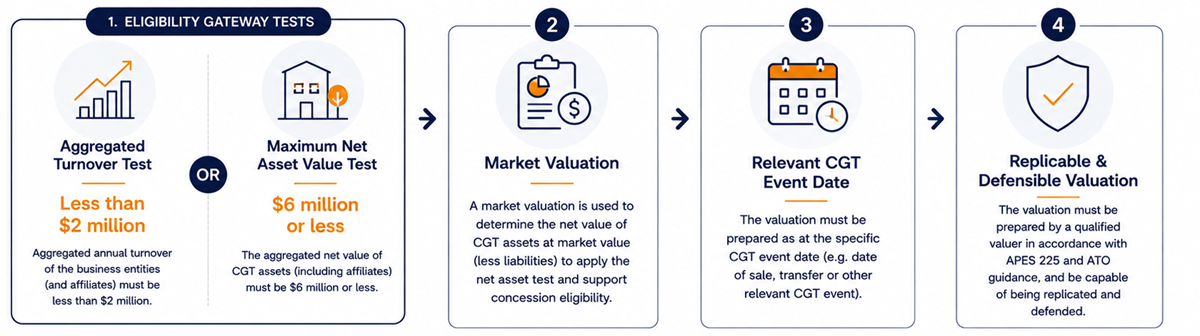
The $6 Million Maximum Net Asset Value Test
Broadly, the Maximum Net Asset Value Test requires the net value of the relevant CGT assets of the taxpayer and specified connected entities and affiliates to not exceed $6 million immediately before the relevant CGT event.
For privately owned businesses, determining whether this threshold is satisfied can require establishing the market value of the business, shares, units or other relevant business interests at the applicable date.
This can be particularly important where the taxpayer’s net asset position is approaching the $6 million threshold.
Unlike listed securities, privately owned businesses and ownership interests generally have no readily observable market price. The value attributed to a business may therefore depend upon its maintainable earnings, assets, goodwill, risks, market conditions and other quantitative and qualitative factors affecting market value.
Relatively small differences in the assessed market value of a substantial business interest can potentially determine whether the Maximum Net Asset Value Test is satisfied.
2026–27 Budget Changes to the Turnover Threshold
The 2026–27 Federal Budget announced an important expansion of access to the Division 152 concessions.
From 1 July 2027, the aggregated turnover threshold for accessing the 50% active asset reduction is proposed to increase from $2 million to $10 million, subject to the applicable eligibility requirements and final legislation.
This distinction is important. The proposed $10 million threshold relates specifically to the 50% active asset reduction and should not be interpreted as increasing the turnover threshold to $10 million for all four Division 152 concessions.
For businesses with turnover above the applicable threshold for a particular concession, the $6 million Maximum Net Asset Value Test may therefore remain highly relevant, subject to the other Division 152 eligibility requirements.
Why Market Value Matters
The Maximum Net Asset Value Test is based upon the market value of relevant assets rather than simply their accounting book value or historical cost.
For a privately owned business, this means the value recorded in the balance sheet may be materially different from its market value.
One particularly important reason is internally generated goodwill.
A successful business may have developed substantial goodwill through its customer relationships, reputation, workforce, systems, intellectual property, market position and capacity to generate sustainable earnings. Much of this value may not appear as an asset on the balance sheet, but it can nevertheless form a significant component of the market value of the business.
Accordingly, relying solely upon financial statements or net tangible assets may provide an incomplete picture of the value relevant to the Maximum Net Asset Value Test.
Valuing Shares and Business Interests for Division 152
Where the relevant asset is an interest in a privately owned company, trust or other entity, the valuation may require more than simply determining the value of the underlying business and multiplying that value by the ownership percentage.
Depending upon the circumstances, consideration may also need to be given to matters such as:
- the rights attaching to the particular shares, units or interests;
- the level of ownership or control represented by the interest (eg. minority interests);
- restrictions affecting transferability;
- distributions and dividend rights (future cash flows);
- shareholder or unitholder agreements; and
- other factors that a knowledgeable market participant would consider when assessing the interest.
The appropriate valuation approach will depend upon the particular asset being valued and the purpose for which the valuation is required.
Establishing a Defensible Division 152 Market Value
Where eligibility for a significant CGT concession depends upon whether net asset value falls above or below a statutory threshold, the basis supporting the valuation conclusion can become particularly important.
An independent Division 152 business valuation should therefore clearly establish the relevant valuation date, identify the business or interests being valued, apply appropriate valuation methodology and support material assumptions and valuation inputs with credible evidence.
BSP Strategic can work alongside a client’s accountant or taxation adviser to prepare an independent market valuation of privately owned businesses, shares and business interests where market value is required in connection with the Division 152 Small Business CGT Concessions and Maximum Net Asset Value Test.
Who Can Prepare an ATO Business Valuation?
For most business valuations undertaken for taxation purposes, there is no single category of professional who is exclusively authorised to determine market value.
The ATO’s guidance places greater emphasis on the quality and reliability of the valuation process than simply the professional title of the person preparing the valuation.
However, determining the market value of a privately owned business, shares or other business interests can require considerable professional judgement, technical knowledge and valuation experience. The ATO therefore recommends considering whether the valuer has the appropriate qualifications, knowledge and experience for the particular asset being valued.
A suitably experienced business valuer should be able to:
- understand the purpose for which the valuation is required and the relevant valuation date;
- identify the appropriate business, asset, shares or ownership interests being valued;
- independently assess the financial and other information provided;
- select and apply recognised valuation methodologies appropriate to the circumstances;
- assess the reasonableness of material assumptions and valuation inputs;
- consider relevant industry, economic and market evidence;
- remain objective when forming a conclusion of market value; and
- clearly document the methodology, evidence, assumptions and reasoning supporting the valuation conclusion.
Independence and Objectivity
Independence can be particularly important where a business valuation may subsequently be subject to review by the ATO or another party.
The role of the valuer is not to produce a predetermined or preferred value for the client. Rather, the valuer should independently assess the available evidence and form an objective conclusion of market value.
The ATO’s guidance specifically notes that taxpayers engaging a valuer should acknowledge the valuer’s independence in reaching their conclusions and should not make the valuer’s fee dependent upon the valuation outcome.
Similarly, APES 225 requires members undertaking a valuation that requires, or purports to have, independence to comply with its independence requirements and not act as an advocate in respect of that valuation.
Professional Qualifications and Business Valuation Expertise
Business valuation is a specialist discipline involving the application of financial analysis, valuation methodology, professional judgement and market evidence.
Professional accounting and valuation bodies provide specialist education, accreditation and professional standards for practitioners undertaking this work. The ATO notes that a valuation prepared by a suitably qualified professional in accordance with commonly accepted professional standards and codes will generally contain stronger evidence and reasoning and is considered more reliable.
BSP Strategic’s business valuations are prepared by a Chartered Accountant and CA ANZ Business Valuation Specialist, combining professional accounting expertise with specialist training and experience in valuing privately owned businesses and business interests.
Valuation engagements are undertaken within the applicable professional valuation framework, including APES 225 Valuation Services and International Valuation Standards.
The Taxpayer Still Has an Important Role
Engaging a professional business valuer does not remove the need for the taxpayer and their taxation adviser to properly establish the purpose of the valuation.
The ATO expects a professional valuer to receive clear instructions and accurate information, including the scope and purpose of the valuation. The taxpayer should also provide the information and access reasonably required for the valuer to undertake their work independently.
For this reason, BSP Strategic can work directly with a client’s accountant or taxation adviser to confirm the valuation purpose, relevant valuation date and business interests to be valued before commencing the engagement.
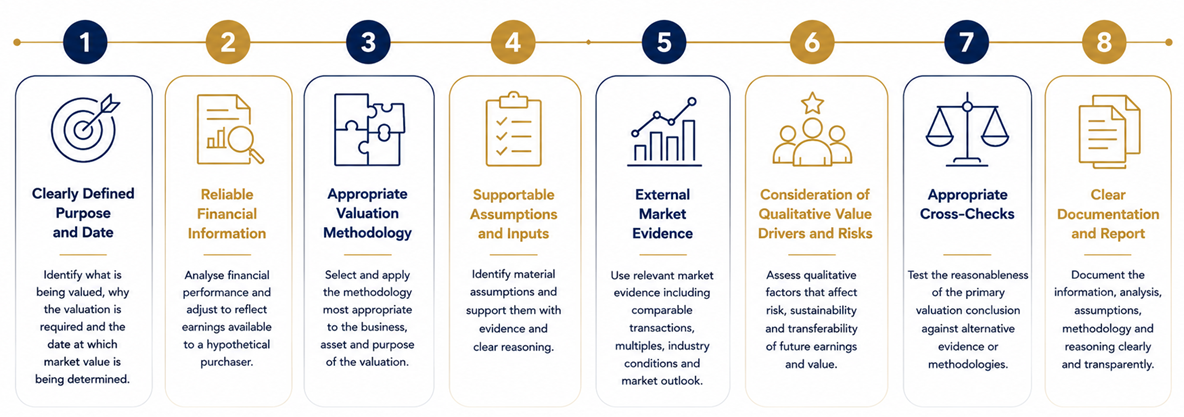
What Makes an ATO Market Valuation Replicable and Defensible?
For taxation purposes, obtaining a valuation figure is only part of the process. The conclusion of market value should also be supported by sufficient evidence, analysis and documentation to explain how that value was determined.
The ATO describes this as the need for a valuation to be “replicable and defensible.”
In practical terms, this means another appropriately qualified professional reviewing the valuation should be able to understand the information relied upon, the methodology applied, the assumptions adopted and the reasoning that led to the conclusion of market value.
A robust business valuation should therefore establish a clear and logical connection between the underlying evidence and the final valuation conclusion.
1. Clearly Defined Valuation Purpose and Date
The report should identify what is being valued, why the valuation is required and the date at which market value is being determined.
For taxation valuations, the purpose is particularly important because the valuation approach needs to be appropriate to the taxation provision or transaction for which market value is required.
2. Reliable Financial Information
The valuation should be supported by appropriate financial information and analysis.
For privately owned businesses, reported accounting profits will often require adjustment before they provide an appropriate measure of the earnings available to a hypothetical purchaser.
This can involve considering matters such as:
- owner remuneration and related-party expenses;
- non-recurring or abnormal income and expenditure;
- discretionary expenditure;
- changes in accounting treatment;
- historical versus current trading performance; and
- the sustainability of earnings expected to continue under new ownership.
Any significant adjustments should be capable of being explained and supported rather than simply being adopted because they produce a preferred valuation outcome.
3. Appropriate Valuation Methodology
The valuation methodology should be appropriate to the business, asset being valued and purpose of the valuation.
Depending upon the circumstances, this may involve an income approach, market approach, asset-based approach or a combination of approaches and methodologies.
The report should explain not simply which methodology was used, but why it was considered appropriate.
Where alternative valuation approaches have been considered but not relied upon, explaining why they were unsuitable can further strengthen the reasoning supporting the conclusion.
APES 225 similarly requires valuation reporting to identify the valuation approaches and methods used and how they were applied.
4. Supportable Assumptions and Inputs
Business valuations inevitably involve professional judgement and assumptions.
These may include maintainable earnings, expected growth, capitalisation multiples, discount rates, working capital requirements or other inputs influencing the valuation.
A defensible valuation should clearly identify material assumptions and, where appropriate, explain the evidence and reasoning supporting them.
The greater the impact an assumption has on the valuation conclusion, the more important its supporting evidence becomes.
5. External Market Evidence
A business valuation should not be prepared in isolation from the market in which the business operates.
Relevant external evidence may include:
- transactions involving comparable businesses;
- observed valuation and transaction multiples;
- industry conditions and outlook;
- merger and acquisition activity;
- economic and financing conditions;
- market participant expectations; and
- other evidence relevant to how a knowledgeable purchaser might assess the business.
The quality of this evidence matters. A transaction involving a superficially similar business is not necessarily a meaningful comparable if its size, profitability, risk, growth prospects or commercial characteristics are materially different.
6. Consideration of Qualitative Value Drivers and Risks
Financial performance is fundamental to business value, but financial statements alone rarely explain the complete value of a privately owned business. (read more about Quantitative Factors).
A valuation should also consider relevant qualitative characteristics that influence the risk, sustainability and transferability of future earnings.
These may include customer concentration, owner dependence, management capability, recurring revenue, intellectual property, competitive position, barriers to entry, supplier dependence and other business-specific risks and value drivers (read more about Qualitative Drivers).
7. Appropriate Cross-Checks
The ATO market valuation for purposes guidelines stipulate, that where practicable, the reasonableness of the primary valuation conclusion should be considered against alternative valuation evidence or methodologies.
A cross-check does not necessarily mean that two different methodologies will produce exactly the same value. Rather, it can help identify whether the primary valuation conclusion is broadly consistent with other available evidence or whether apparent differences require further investigation.
8. Clear Documentation and Valuation Report
Finally, the analysis needs to be appropriately documented.
A valuation report should allow the reader to understand the information relied upon, adjustments made, assumptions adopted, methodology applied and reasoning supporting the conclusion of market value.
APES 225 places specific obligations on valuation reporting and documentation and requires sufficient and appropriate evidence to provide reasonable grounds for the valuation conclusion.
This documentation can become particularly important if the valuation is subsequently reviewed by the ATO or needs to be relied upon several years after it was originally prepared.
Business Valuation Methods for Tax Purposes
There is no single valuation method that is appropriate for every business.
The methodology adopted for an ATO market valuation or business valuation for tax purposes should reflect the nature of the business, the asset or interest being valued, the purpose of the valuation and the information reasonably available at the relevant valuation date.
Broadly, business valuations are generally undertaken using one or more of three recognised valuation approaches.
Market Approach
The market approach determines value by reference to observable market evidence, such as transactions involving comparable businesses or valuation multiples derived from relevant market data.
For privately owned businesses, this may involve considering:
- transactions involving comparable businesses;
- earnings or revenue multiples observed in the market (trading multiples);
- the size, profitability and risk profile of comparable businesses;
- industry conditions and buyer demand; and
- differences between the subject business and available market evidence.
The market approach can be particularly useful where sufficient and genuinely comparable transaction evidence is available.
However, care is required. A transaction involving a business in the same industry is not automatically comparable. Differences in scale, profitability, customer concentration, growth prospects, management structure, recurring revenue, risk and other qualitative factors can materially affect the valuation multiple that a market participant would be prepared to pay.
Income Approach
The income approach determines value by reference to the future economic benefits expected to be generated by the business.
Depending on the circumstances, this may involve capitalising maintainable earnings or discounting forecast future cash flows to present value.
This approach requires careful consideration of matters including:
- sustainable or maintainable earnings;
- future growth expectations;
- business risk;
- working capital and capital expenditure requirements;
- forecast cash flows;
- discount rates or capitalisation rates; and
- the reliability of management forecasts and assumptions.
For privately owned businesses, adjustments may also be required to reported earnings to reflect the level of earnings reasonably available to a hypothetical purchaser.
Cost or Asset-Based Approach
The cost or asset-based approach considers the value of the underlying assets and liabilities of the business or, in some circumstances, the cost of recreating or replacing particular assets.
This approach can be more relevant where:
- the business is asset-intensive;
- earnings do not provide the primary indication of value;
- the business is being assessed on a net asset basis; or
- particular tangible or intangible assets need to be valued separately.
For an established profitable business, however, an asset-based approach may not fully capture the value of internally generated goodwill, customer relationships, intellectual property or the business’s capacity to generate future earnings.
Why the Choice of Method Matters
Selecting an appropriate valuation methodology is an important part of producing a replicable and defensible valuation.
ATO market valuation guidelines note that the valuation should explain:
- why the selected methodology was chosen;
- why it is considered appropriate to the particular circumstances; and
- where relevant, why alternative methodologies were not relied upon.
The ATO also identifies inappropriate choice or application of methodology, unsupported assumptions and insufficient market evidence as common valuation problems.
Using More Than One Valuation Method
Where appropriate, a secondary valuation method or reasonableness cross-check can provide additional support for the primary valuation conclusion.
The purpose of a cross-check is not necessarily to produce exactly the same value using two different methods. Rather, it helps assess whether the primary conclusion is broadly consistent with other available valuation evidence and can highlight areas requiring further investigation.
For example, a maintainable-earnings valuation might be cross-checked against available transaction multiples, an implied return on investment or another appropriate valuation measure.
The choice and weighting of valuation approaches ultimately depends on the circumstances of the particular business and the purpose for which market value is being determined.
Professional Valuation Standards — APES 225 & IVS
A professional business valuation should be prepared within an established framework of professional and valuation standards.
For valuations undertaken by members of the Australian accounting profession, APES 225 Valuation Services establishes professional and ethical requirements applying to valuation engagements.
APES 225 addresses matters including the type and scope of valuation engagement, professional competence, objectivity, independence where applicable, use of valuation methodologies, assumptions, evidence, documentation and reporting.
For a client relying upon a business valuation for taxation purposes, compliance with recognised professional standards provides an important framework around how the valuation is undertaken and how the conclusion of value is supported and communicated.
International Valuation Standards
The International Valuation Standards (IVS) provide a globally recognised framework for undertaking and reporting valuations across different asset classes, including businesses and business interests.
IVS establishes fundamental valuation concepts including:
- the basis of value being adopted;
- the relevant valuation date;
- appropriate valuation approaches and methods;
- the use of assumptions and inputs;
- consideration of relevant market evidence; and
- documentation and reporting of the valuation conclusion.
BSP Strategic’s Professional Valuation Framework
BSP Strategic’s business valuations are prepared by a Chartered Accountant and CA ANZ Business Valuation Specialist and undertaken within the applicable professional valuation framework, including APES 225 Valuation Services and relevant International Valuation Standards.
This framework complements the ATO’s emphasis on valuations being replicable and defensible — supported by appropriate methodology, credible evidence, documented assumptions and clear professional reasoning.
Importantly, professional standards do not prescribe a predetermined valuation outcome. Their purpose is to provide a disciplined framework within which the valuer exercises independent professional judgement in determining and supporting market value.
Common Problems with Business Valuations for ATO Purposes
Business valuations prepared for taxation purposes can be subject to review by the Australian Taxation Office. The ATO’s published guidance identifies a range of recurring issues it encounters when reviewing market valuations.
These problems do not necessarily arise because a valuation calculation is mathematically incorrect. More commonly, weaknesses can arise from the methodology selected, information relied upon, assumptions adopted or evidence supporting the valuation conclusion.
Common issues identified by the ATO include:
- inappropriate selection or application of valuation methodology;
- assumptions or valuation inputs that are unreasonable or insufficiently supported;
- insufficient analysis of underlying financial and operational information;
- inappropriate selection of comparable businesses or transactions;
- insufficient market evidence supporting valuation multiples, discount rates or other inputs;
- omission of information relevant at the valuation date;
- inappropriate reliance on subsequent events or the benefit of hindsight;
- unsupported adjustments or apportionments;
- inconsistencies between the valuation and other available evidence; and
- insufficient documentation of the assumptions and reasoning supporting the valuation conclusion.
Why These Issues Matter
For an ATO market valuation, the ultimate value is only as reliable as the evidence and reasoning supporting it.
A valuation may therefore be challenged even where the final number appears reasonable if it is difficult to demonstrate how the conclusion was reached, why the methodology was appropriate or whether the underlying assumptions were supportable at the valuation date.
This reinforces the ATO’s broader expectation that a market valuation should be objective, supported by appropriate evidence and capable of being substantiated if subsequently reviewed.
Rather than reproducing each potential valuation issue here, BSP Strategic has prepared a detailed guide examining the common problems encountered in business valuation reports and how they can affect the reliability of a valuation.
BSP Strategic’ ATO Market Valuation Process
Every taxation-related valuation has different circumstances. Before commencing an engagement, BSP Strategic seeks to clearly establish what is being valued, why the valuation is required and the relevant valuation date.
This is particularly important for ATO market valuations, where the taxation purpose should be established with the client and their accountant or taxation adviser before the valuation work commences.
1. Establish the Valuation Purpose & Scope
We initially discuss the valuation requirement with the client and, where appropriate, their accountant or taxation adviser.
This typically includes confirming:
- the taxation purpose for which the valuation is required;
- the business, shares or business interests being valued;
- the relevant valuation date;
- the legal and ownership structure;
- whether a controlling or minority interest is being valued; and
- any particular circumstances relevant to the engagement.
Clearly defining these matters at the outset helps ensure the valuation addresses the purpose for which it will ultimately be relied upon.
2. Information Gathering & Business Analysis
BSP then obtains the financial, operational and other information necessary to understand the business and undertake the valuation.
The scope of information required will depend upon the business and valuation purpose, but generally includes historical financial performance together with information concerning the business model, operations, ownership, customers, suppliers, employees, key assets, industry and other factors relevant to value.
3. Financial Analysis & Normalisation
Historical financial performance is analysed to assess the underlying earnings and financial characteristics of the business.
Where appropriate, adjustments may be considered for non-recurring items, owner-related expenses or remuneration, related-party transactions and other matters that may affect an assessment of sustainable or maintainable earnings.
Material adjustments should be supportable and appropriately documented.
4. Valuation Analysis & Market Research
An appropriate valuation methodology is selected having regard to the business, valuation purpose and available evidence.
This may include analysis of maintainable earnings or cash flows, comparable transactions, market valuation multiples, industry conditions, economic factors and relevant qualitative characteristics affecting business value.
Where appropriate, alternative methodologies or market evidence may also be used to cross-check the reasonableness of the primary valuation conclusion.
5. Valuation Review & Documentation
The valuation analysis, assumptions, methodology and supporting evidence are reviewed to ensure there is a clear and logical basis for the conclusion of market value.
This documentation is particularly important for taxation-related valuations, where the basis upon which market value has been determined may subsequently need to be explained or substantiated.
6. Independent Business Valuation Report
BSP provides a written valuation report setting out the scope and purpose of the engagement, valuation date, information relied upon, methodology, material assumptions and the resulting conclusion of market value.
This aligns with the professional reporting framework under APES 225, which requires written valuation reports to address matters including the asset or interest valued, valuation date, purpose, scope, basis of valuation, methodology, information relied upon and material assumptions.
Information Typically Required for an ATO Business Valuation
The information required will vary depending upon the business, taxation purpose and valuation date.
For a typical privately owned business, BSP may request:
- historical financial statements;
- current management accounts;
- budgets and financial forecasts;
- details of significant normalisation or non-recurring items;
- company, trust and ownership structures;
- details of the shares, units or business interests being valued;
- information regarding owners and key management;
- shareholder agreements;
- major customer and supplier information;
- significant contracts, leases and commercial agreements;
- details of intellectual property or other intangible assets;
- information concerning debt, surplus assets or other relevant balance-sheet items; and
- other operational, industry or commercial information relevant to understanding the business.
For a historical or retrospective valuation, additional information existing around the relevant valuation date may be particularly important.
The objective is not simply to collect financial statements. It is to obtain sufficient information to understand how the business generated its earnings, the risks associated with those earnings and the factors a knowledgeable market participant would have considered when assessing value.
Working With Your Accountant or Tax Adviser
ATO market valuations frequently sit at the intersection of taxation advice and business valuation advice.
These are related but distinct professional disciplines.
Your accountant or taxation adviser should determine the taxation provisions relevant to your circumstances, including whether a market valuation is required, the relevant CGT event or taxation provision and how the resulting valuation will be used.
BSP Strategic’s role is to independently determine and support the market value of the relevant business, shares or business interests.
Where appropriate, BSP can work directly with your accountant or taxation adviser to confirm:
- the purpose of the valuation;
- the appropriate valuation date;
- the entity, asset or ownership interest being valued;
- the required scope of the valuation; and
- any particular matters that need to be addressed within the valuation report.
This collaborative approach helps ensure that the valuation work and taxation advice address the same underlying transaction and purpose, while maintaining the independence and objectivity of the valuation conclusion.
Why BSP Strategic for ATO Market Valuations?
Business valuation is a specialist discipline requiring a combination of financial analysis, valuation methodology, market evidence and professional judgement.
BSP Strategic specialises in the valuation of privately owned Australian businesses and business interests, with particular focus on the factors that influence the value, risk and transferability of SME earnings.
Our approach to ATO and taxation-related valuations incorporates:
Specialist valuation expertise
Valuations are prepared by a Chartered Accountant and CA ANZ Business Valuation Specialist.
Independent professional judgement
Our role is to independently assess market value based upon the available evidence rather than seek to substantiate a predetermined valuation outcome.
Understanding of privately owned businesses
Private businesses have characteristics that are often not adequately reflected in their financial statements alone. BSP considers both financial performance and the qualitative factors influencing risk, earnings sustainability and value.
Market and transaction perspective
Valuation analysis considers relevant market evidence, industry conditions, M&A activity and the commercial factors influencing how market participants assess privately owned businesses. BSP has access to a curated selection world class databases to provide highly credible support for transaction and trading multiples and markets.
Recognised professional framework
Valuation engagements are undertaken within the applicable professional valuation framework, including APES 225 Valuation Services. The current APES 225 standard applies to members providing valuation services and places particular obligations around valuation reporting and documentation.
Replicable and defensible conclusions
Our objective is not simply to calculate a number. It is to provide a clearly reasoned and appropriately documented conclusion of market value supported by methodology, evidence and professional judgement.
Frequently Asked Questions – ATO Market Valuations