
How to Value a Small Business – The Complete Guide
Whether you’re buying, selling, restructuring, or raising capital, understanding how to value a small business is essential. This guide walks you through the key concepts, valuation methods, and professional standards, with links to detailed resources on each topic.

What is Business Valuation?
Business valuation is the process of determining the economic value of a business or an ownership interest in a business. For small and medium-sized enterprises (SMEs), valuation typically considers a mix of financial performance, future earnings potential, industry benchmarks, and qualitative factors such as customer base, brand strength, and operational risk.
Valuations can range from informal estimates to formal, independently prepared reports. When required for regulatory, tax, or legal purposes, formal business valuations are typically conducted in accordance with professional standards such as:
- APES 225 – Valuation Services, issued by the Accounting Professional & Ethical Standards Board, which governs ethical and professional obligations for accountants providing valuation services in Australia.
- IVS – International Valuation Standards, published by the International Valuation Standards Council, which provides globally recognised valuation principles and methodologies.
These standards ensure that valuations are objective, transparent, and fit for purpose.

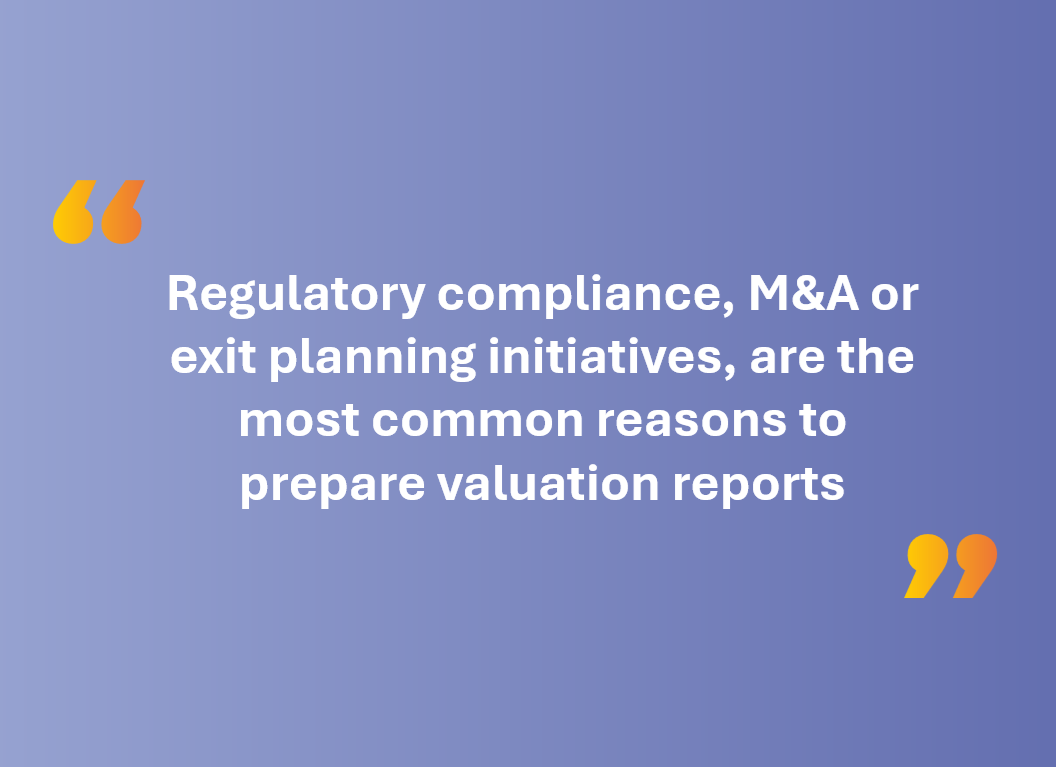
Why Do Australian SME’s Need Business Valuations?
Formal and informal business valuations may be required to satisfy a wide variety of regulatory and stakeholder requirements, some of the more common reasons include:
Scoping The Engagement
As you would expect – Businesses come in all shapes and sizes. Different business models, stages of life cycle, legal and ownership structures. Prior to any valuation engagement the valuer must seek to understand a wide range of characteristics that have potential to influence the choice of valuation methodology (the type of valuation procedures performed) which has direct consequences on the assessed valuation outcome.
During this scoping phase (prior to engagement) the valuer should seek to confirm the following (as a minimum).
- The purpose of the valuation & how it will be used?
- Who is/are the instructing party/ies?
- What is the legal and ownership structure of the business/group?
- What are we valuing (Enterprise or Equity)
- Controlling or minority interests?
- What is the proposed date of valuation?
- What is the premise of value (highest & best use, current use, orderly liquidation & forced sale).
- Trading history and historical performance/profitability
- Level of tangible assets as compared to profitability
- Degree of owner involvement and other major potential normalisations
- What information is available?
Approaches & Methodologies
Several valuation methodologies exist within each of the three prescribed valuation approaches. Consequently, the valuer must exercise professional judgement in their selection of methodology as well as document their reasoning for adoption.
Basis Of Value
It is important to note aside from Market Value there are several other defined “Basis of Value” which may be used for valuation purposes (eg. Fair Value, Synergistic Value, Equitable Value, Liquidation Value).
IVS define Market Value to be the “estimated amount for which an asset and/or liability should exchange on the valuation date between willing buyer and a willing seller in an arm’s-length transaction, after proper marketing and where parties had each acted knowledgeably, prudently and without compulsion”.
The Australian Taxation Office (ATO) does not provide its own specific definition of market value for taxation purposes however considers the IVS definition (noted above) to be consistent with the judicial meaning which notes “a valuer is to assume a market with hypothetical buyers and sellers and the “market value”, being the price negotiated between the buyer and the seller to achieve a notional sale in the hypothetical market”.
Valuers also adopt a stated premise of value such as “highest and best use”, Current Use/Existing Use, Orderly Liquidation or Forced Sale. Within the business valuation arena we typically value businesses on a “going-concern basis” or across a finite project period.
Valuation Metrics
When valuing a business it is important review the manner in which comparable businesses are bought and sold. Often businesses operating within the same industry sector will transact on the same “base of value”.
For example, we often find that SaaS businesses trade based on multiples of revenue as this more closely reflects the subscription based nature of their business models. A manufacturing business however (which is required to continually invest in capital plant and equipment) is more likely to transact on an Earnings base such as EBIT or EBITDA.
Bases of value are usually expressed as a multiple of the Enterprise Value (EV):

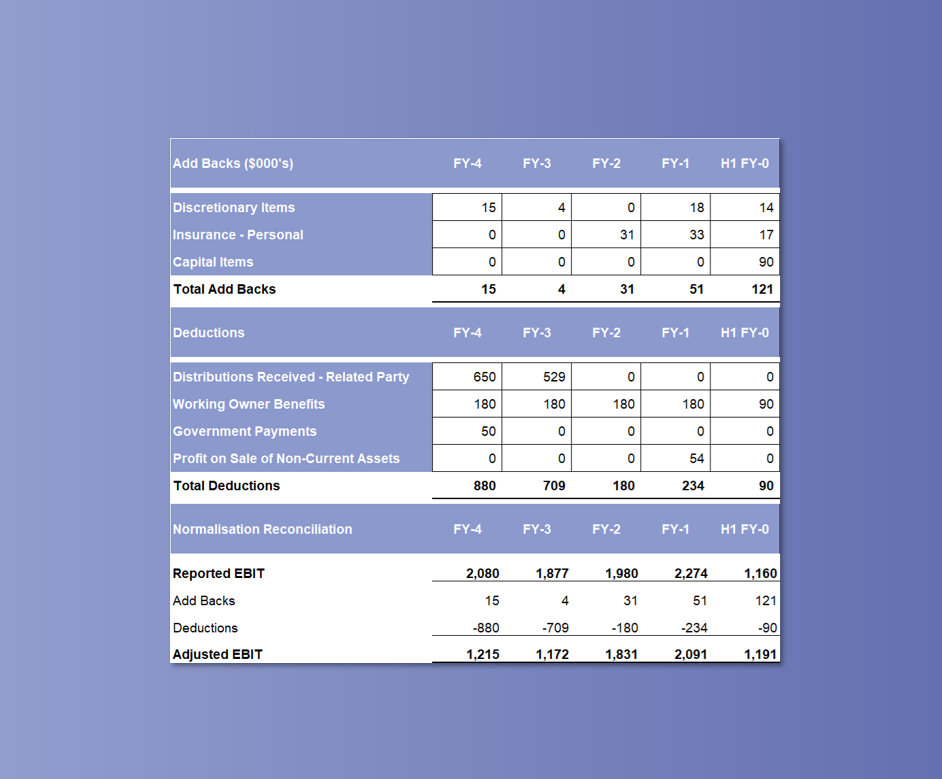
Normalisation of the “Reported” results to the “Adjusted” results ensures that the earnings figure used in a valuation reflects what a hypothetical buyer can reasonably expect to earn going forward under normal operating conditions.
Normalisations (Addbacks/Deductions)
Normalisation is a crucial step in the business valuation process. Its objective is to adjust the Financial Statements to reflect the true Maintainable Earnings of the business, excluding any anomalies that don’t accurately represent ongoing business operations.
Why is Normalisation Important?
Financial Statements often contain items that are:
- Unique to the current owners (discretionary, personal expenses)
- Not consistent from year to year (extraordinary, abnormal, accounting policy changes, non-recurring items, etc)
- Influenced by tax minimisation strategies
- Not reflective of fair market value (non-commercial arrangements / not-arm’s length, related party transactions, timing differences)
Valuation Multiples
Multiples – otherwise known as Capitalisation rates, or Multipliers are one of the most influential variables in determining business value – this is especially true when using an earnings-based-approach.
Why is the multiple so important?
- Translates Earnings into Value
The multiple converts a business’s normalised earnings into a total value. For example, a business with $1,500,000 in EBITDA and a 4× multiple is valued at $6.0 million. A small change in the multiple (e.g. from 4× to 4.5×) can dramatically affect the final valuation.
- It Captures Risk and Growth Opportunities
The multiple reflects how attractive or risky a business is. It implicitly accounts for:
-
- Industry stability/volatility and growth potential
- Competitive position and market share
- Customer diversity and recurring revenue
- Owner dependency and key person risk
- Economic conditions and interest rates
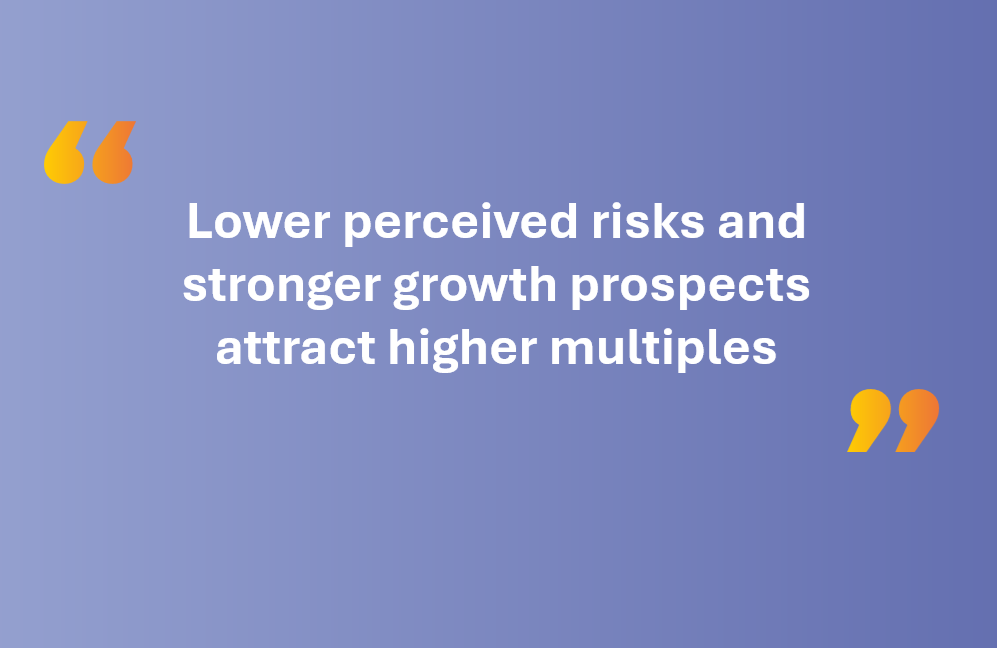
At a high level the general assumption is lower risk and stronger growth prospects = higher multiples.
- It Allows Benchmarking Across the Market
Multiples are widely used for comparing businesses within an industry. Buyers, investors, and valuers rely on them to assess whether a price is fair based on recent comparable sales and industry norms.
- Multiples are key Negotiation Levers
As multiples are subjective, the multiple is often the focus of negotiation in deals. Sellers aim to justify a higher multiple by demonstrating stability, scalability, and strategic value, while buyers may argue for a discount due to risk or integration challenges.
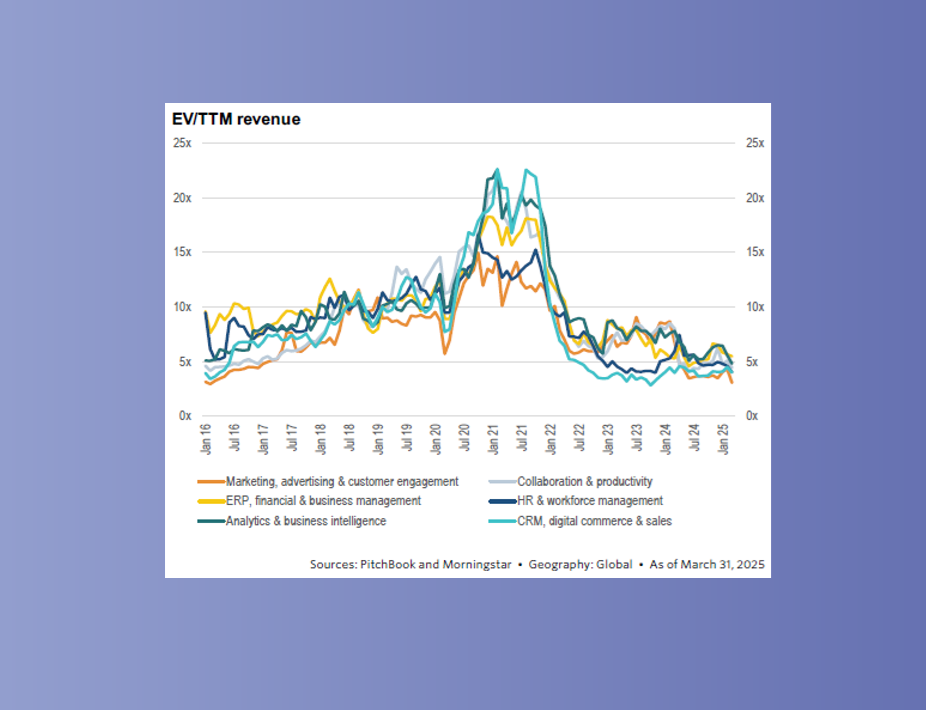
SME Multiples are influenced by a wide range of factors including public trading comparisons (stock market valuations). Industry specific valuation multiples are volatile and constantly move through cycles of peaks and troughs as illustrated by the chart above depicting Revenue Multiples for Public-Trading SaaS enterprises over the past decade.

Regulatory Audits
Various bodies undertake audit or review processes in the context of business valuations. Some of the more prominent are detailed below.
- The Australian Taxation Office (ATO)
- Office of State Revenue (OSR)
- Family Law Courts
- External Financial Auditors
- Australian Securities & Investments Commission
- Independent Experts