
1 July 2027 CGT Changes – Market Valuation or Treasury’s Nine-Step Formula?
From 1 July 2027, changes to Australia’s CGT regime create an important valuation consideration for owners of privately held businesses, shares and other business interests.
Where value needs to be allocated between the periods before and after 1 July 2027, business owners may need to consider whether to rely on Treasury’s proposed nine-step apportionment method or establish actual market value at the transition date.
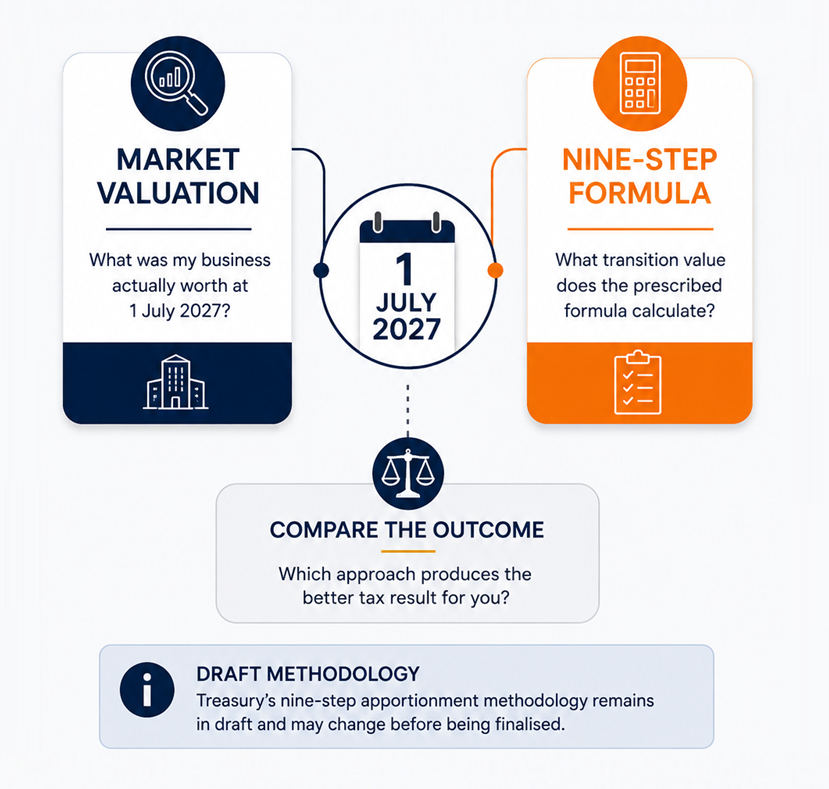
Market Valuation vs Nine-Step Apportionment Methodology…. Understand the Difference
Why 1 July 2027 Matters
From 1 July 2027, Australia’s CGT rules change for individuals and relevant trusts. The new arrangements apply to capital gains accruing from that date, while gains attributable to the period before 1 July 2027 retain their existing treatment.
For assets held across the transition date, the legislation effectively creates a valuation reference point at 1 July 2027. This can be particularly important for owners of privately held businesses, company shares and other business interests where there is no readily observable market price.
Broadly, the legislation provides two ways of determining the transition value:
Market Value — establish what the business, shares or relevant interest was actually worth immediately before 1 July 2027; or
Apportionment Method — elect to use the prescribed methodology to calculate the amount attributable to the pre-1 July 2027 period.
Importantly, the choice does not necessarily need to be made at 1 July 2027. For individuals, the legislation allows the choice to be deferred until the relevant asset is ultimately realised and the applicable tax return is lodged.
Market Valuation vs Treasury’s Nine-Step Apportionment Methodology
For relevant assets held across 1 July 2027, the legislation provides two alternative ways of determining the value attributed to the pre-1 July 2027 period.
Option 1 — Market Valuation
The default approach is to establish the asset’s market value immediately before 1 July 2027. The legislation effectively treats the asset as having been sold immediately before the transition date and reacquired for that amount.
For a privately owned business or unlisted shares, this requires determining what the relevant business interest was actually worth at that date, having regard to its financial performance, earnings, risks, market conditions and other factors influencing value.
Option 2 — Treasury’s Proposed Apportionment Method
Alternatively, the legislation allows a taxpayer to choose a prescribed apportionment method rather than establish actual market value. Treasury’s currently proposed methodology uses a nine-step calculation to determine the amount attributable to the transition date.
Why the Choice Matters
Business value rarely develops in a perfectly even pattern.
A business may experience rapid growth, win or lose major contracts, develop valuable intellectual property, make acquisitions, enter new markets or be affected by changing technology, regulation, economic conditions or M&A activity.
As a result, the actual market value at 1 July 2027 could be materially different from the value produced by the proposed formula.
Neither approach should automatically be assumed to produce the better taxation outcome. That decision should be considered with the business owner’s accountant or taxation adviser after comparing the alternatives.
Why Market Value and the Nine-Step Apportionment Methodology May Produce Different Outcomes
The value of a privately owned business rarely grows at a constant rate.
Changes in earnings, customers, management, technology, industry conditions, acquisitions, economic conditions and M&A activity can cause substantial amounts of business value to be created — or lost — within relatively short periods.
Treasury’s proposed nine-step methodology provides a formula-based method of allocating gains across the transition date. An independent market valuation takes a different approach: it seeks to establish what the business or business interest was actually worth immediately before 1 July 2027.
This means the two approaches can potentially produce different results.
The important point is not that market valuation will always produce a better result. It won’t. The value lies in understanding whether actual market value at 1 July 2027 differs materially from the result produced by the prescribed formula.
The tax consequences of choosing either approach should ultimately be determined with the taxpayer’s accountant or taxation adviser.
Important: These examples are illustrative only and intentionally simplify the calculations. Treasury’s nine-step apportionment methodology remains in draft and may change before being finalised. The current draft calculates an implied growth rate using matters including cost base, eventual capital proceeds and the number of days the asset has been held
Should I Obtain a Business Valuation at 1 July 2027?
Not necessarily.
The new CGT arrangements do not mean that every business owner needs to obtain a business valuation on 1 July 2027.
Under the legislation, the choice between using market value and the prescribed nine-step apportionment method can generally be deferred until the relevant asset is ultimately realised.
However, obtaining—or at least considering—a market valuation around 1 July 2027 may be worthwhile where:
- the business has experienced significant or uneven growth;
- substantial value has been created in the years leading up to 1 July 2027;
- the potential future capital gain is significant;
- there is a reasonable prospect that market value and the prescribed formula could produce materially different outcomes; or
- establishing the business’s value many years later could become difficult.
The Retrospective Valuation Issue
A 1 July 2027 market valuation can potentially be undertaken retrospectively when the business or shares are eventually sold.
The practical difficulty is evidence.
If a business is sold in 2035 or 2040, a valuer may need to reconstruct the financial performance, maintainable earnings, customers, contracts, management structure, industry conditions, M&A environment and valuation multiples that existed many years earlier.
For business owners who decide not to obtain a valuation at 1 July 2027, retaining comprehensive financial, operational and market information around the transition date may therefore become particularly important.
Working With Your Accountant or Tax Adviser
The decision to use market value or Treasury’s prescribed nine-step apportionment method is ultimately a taxation decision and should be considered with your accountant or taxation adviser.
Where an independent market valuation is required, BSP Strategic’s role is to determine and support the market value of the relevant business, shares or business interests at 1 July 2027.
BSP can work directly with your accountant or taxation adviser to ensure the valuation engagement clearly establishes:
- the relevant business, shares or ownership interests being valued;
- the appropriate valuation date and purpose; and
- the information and scope required to support a replicable and defensible market valuation.
This separation of roles is important: your tax adviser determines how the CGT provisions apply to your circumstances; BSP independently determines market value where a valuation is required.
The objective is to give business owners and their advisers a credible market value that can be compared with the outcome produced by the prescribed apportionment methodology.