


The Increasing Importance of ATO Compliant Business Valuations in SME Exit Planning
The 2026 Federal Budget may represent one of the most significant shifts in Australian capital gains taxation since the original introduction of the CGT discount regime in 1999. For SME business owners in the approximately $3 million to $30 million enterprise value range, the proposed reforms materially increase the importance of early tax structuring, ATO-compliant business valuation and strategic exit planning prior to 1 July 2027.
Under the proposed reforms, the Government intends to replace the current 50% Capital Gains Tax (CGT) discount with an inflation-indexation methodology and introduce a minimum 30% tax rate on capital gains from 1 July 2027. Importantly, the existing Division 152 small business CGT concessions are proposed to remain unchanged.
For many privately owned businesses, this creates a substantial divergence between:
- business owners who qualify for Division 152 concessions; and
- those who do not.
As a result, obtaining an ATO compliant business valuation (also known as market valuation) is likely to become increasingly critical over the next 12–24 months. Put simply business owners need to understand whether or not they are likely to be able to access the concessions on exit in order to save potentially hundreds of thousands or even millions of dollars in additional tax. For example, are you likely to under the $6m threshold at the time of exit?
Business owners also need to understand current and potential sale value ahead of an exit under both asset and share sale scenarios. This detail will assist with sale preparations and substantially increase potential for reduced tax on sale.
ATO Compliant Business Valuation Required to Seperate Pre & Post 1st July 2027 Gains
The proposed reforms appear to adopt a transitional approach whereby assets will effectively require a market valuation (ATO compliant business valuation) as at 1 July 2027 in order to separate:
- pre-transition gains (potentially still benefiting from the existing 50% CGT discount); and
- post-transition gains subject to the new indexation methodology and minimum 30% tax regime.
This has major implications for SME business owners.
For illiquid private businesses, unlike listed shares, there is no readily observable market value. Accordingly, many business owners may require a robust independent ATO compliant business valuation (market valuation) prepared in accordance with accepted valuation standards and capable of withstanding ATO scrutiny.
This is particularly relevant for:
- family businesses;
- professional services firms;
- logistics and transport businesses;
- fire protection and HVAC businesses;
- manufacturing businesses;
- engineering and consulting firms;
- wholesale and distribution companies; and
- privately owned groups operating through discretionary trust and company structures.
The practical importance of obtaining an ATO-compliant business valuation prior to 1 July 2027 is likely to extend beyond simple tax compliance. In many cases, the valuation may ultimately determine the baseline cost base used to calculate future capital gains under the proposed indexed regime.
Obtaining An ATO Compliant Business Valuation Is Now Critical For High Growth Businesses
The issue becomes even more significant where businesses have experienced substantial historical growth. Many SMEs established decades ago have very low original cost bases. Under the current rules, the 50% CGT discount significantly softens the tax burden. However, under the proposed system, future gains above indexed inflation may become more heavily taxed, particularly where the business continues to grow strongly after 1 July 2027.
For SME owners considering an exit within the next three to five years, strategic timing may therefore become critical.
As an example, A business has an Enterprise Value of $4.0m at 30th June 2026 and is projected to grow at 15% per annum for the next few years. Assuming the business was sold in the near term the owner may be eligible for the Small Business CGT Concessions (Div 152) which depending on the personal situation may eliminate the $4m gain to nil (assuming a nil cost base). However if the business was not sold until 3 years later (eg June 2029) the Enterprise Value may have grown to $6.1m resulting in loss of the eligibility for the concessions and a multi-million dollar uplift in tax on sale.
The point is – it doesnt take much growth over the short term to push the value over the key threshold and result in a substantial tax increase. Obtaining an ATO Compliant Business Valuation through the exit planning stages is an investment in maximising your after tax sale proceeds.
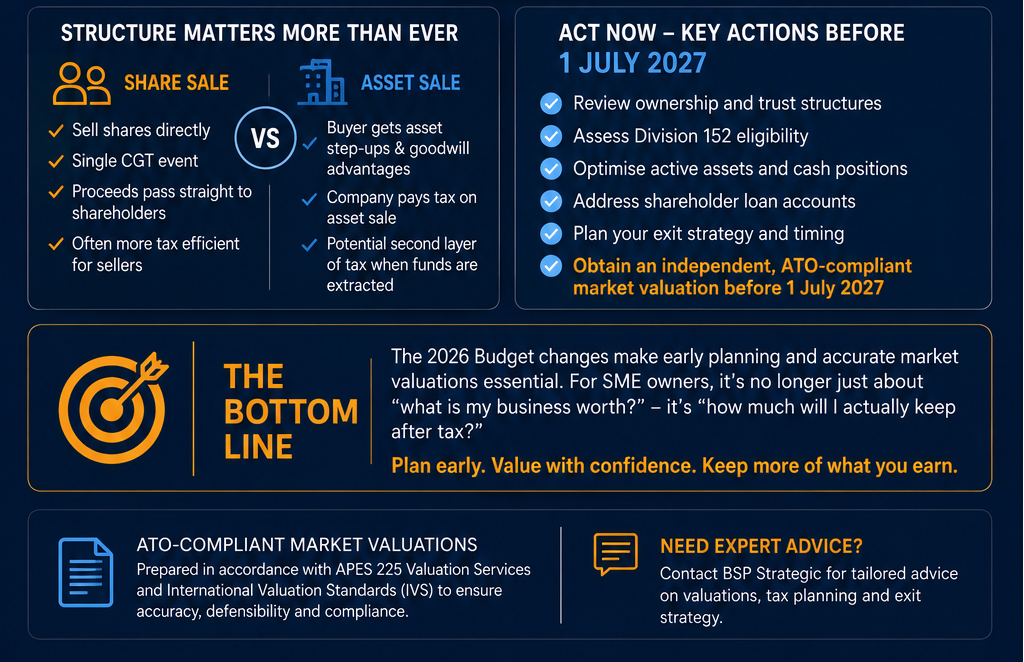
Trading Structure is Becoming Increasingly Important to Your Net After Tax Sale Proceeds
The structure through which the business is owned also becomes increasingly important.
For businesses held directly by individuals or discretionary trusts, the current 50% CGT discount has historically delivered highly favourable outcomes in share or unit sales. However, under the proposed reforms, those concessions may narrow significantly for taxpayers who do not qualify for Division 152 relief.
By contrast, businesses held within companies already do not benefit from the 50% CGT discount. Corporate structures generally pay tax at either 25% or 30%, depending on eligibility for the base rate entity rules. However, corporate asset sales often create a second layer of taxation when sale proceeds are extracted from the company to shareholders.
Tax Scenario Planning Around Deal Structure Increasingly Important
This distinction between asset sales and share sales is likely to become increasingly important in SME transactions.
In a share sale:
- shareholders generally sell shares directly;
- proceeds bypass the company tax layer; and
- there is typically a single CGT event.
In an asset sale:
- the company sells individual assets;
- tax may arise on trading stock, depreciating assets and goodwill separately;
- balancing adjustments may apply;
- and shareholders may later incur additional tax when profits are distributed.
For many SMEs in the $6 million+ Enterprise Value range, this creates a substantial “tax asymmetry” between buyers and sellers.
Buyers often prefer asset acquisitions because they obtain:
- depreciation step-ups;
- amortisable goodwill;
- cleaner liability separation; and
- reduced historical risk exposure.
Sellers, however, frequently prefer share sales because they may produce materially superior after-tax outcomes.
The proposed CGT reforms may intensify these negotiations further.
Access To The Small Business CGT Concesssions Capped at $6m
The proposed budget changes will see the Division 152 concessions become increasingly valuable.
The four primary Division 152 concessions include:
- the 15-year exemption;
- the 50% active asset reduction;
- the retirement exemption; and
- rollover relief.
For eligible taxpayers, these concessions can still substantially reduce — or in some cases eliminate — CGT on the sale of an active business asset.
However, qualification is not straightforward.
Eligibility commonly requires analysis of:
- the $6 million maximum net asset value test;
- active asset status;
- connected entities and affiliates;
- trust structures;
- passive investment assets;
- excess cash reserves;
- shareholder loan accounts; and
- whether goodwill qualifies as an active asset.
This is why professionally prepared business valuations are likely to become increasingly important in pre-sale structuring and Division 152 eligibility analysis.
ATO-Compliant Business Valuations Provides Exit Planning Clarity
How ATO-Compliant Business Valuations may assist:
- determining active asset proportions;
- assessing the 80% active asset test for shares and units;
- supporting restructuring transactions;
- evidencing market value substitution rules;
- supporting tax consolidation decisions;
- succession planning; and
- defending valuation positions in the event of ATO review.
Importantly, the ATO has historically scrutinised business valuations where:
- methodologies are poorly explained;
- assumptions are unsupported;
- maintainable earnings are not normalised appropriately;
- related party transactions distort results; or
- valuation reports fail to comply with recognised standards.
Accordingly, many SME owners should consider obtaining an independent ATO Compliant Business Valuation prepared in accordance with:
- APES 225 Valuation Services;
- International Valuation Standards (IVS); and
- accepted market valuation methodologies.
For businesses in the mid-market SME sector, this commonly includes:
- Capitalisation of Earnings methodologies;
- Discounted Cash Flow analysis;
- Comparable Transactions analysis; and
- Comparable Public Company methodologies.
How Much Of The Sale Proceeds Will I Keep After Tax?
The 2026 Federal Budget therefore does not simply represent a tax reform event. It is likely to accelerate the importance of strategic exit readiness across the SME market.
Business owners considering a future exit should now be proactively reviewing:
- ownership structures;
- trust arrangements;
- Division 152 eligibility;
- surplus asset positions;
- shareholder loan accounts;
- succession plans; and
- independent market valuations prior to 1 July 2027.
Ultimately, the key question for many SME owners is no longer simply:
Instead, it increasingly becomes:
“How much of the sale proceeds do I actually keep after tax?”
In the emerging post-2027 environment, that distinction may become one of the most important drivers of SME exit strategy and transaction structuring in Australia.
Disclaimer:
The information contained in this article is general in nature only and has been prepared for informational purposes. It does not constitute taxation, financial or legal advice and should not be relied upon as such. The application of the proposed 2026 Federal Budget changes, including any CGT implications, will depend on individual circumstances, ownership structures and eligibility for relevant concessions. Readers should seek independent advice from a suitably qualified tax adviser, accountant or legal professional before making any decisions or taking any action in relation to business structuring, valuations or exit planning. BSP Strategic does not provide taxation or legal advice.
Get in touch!
Looking to unlock the full value of your business?
BSP Strategic offers expert guidance in business valuations, strategic planning, and exit strategies tailored to your unique goals.
Get in touch today to see how we can help you maximise your business’s potential and achieve the best possible outcome.